
Why Enterprise AI Has Stayed Generic
Last year, an MIT study found that about 95% of generative AI pilots had delivered little or no measurable impact on profit and loss (Fortune, August 2025). The number was disputed, but most people who have run one of these projects recognized the pattern. A company rolls out a copilot, then builds an assistant that answers questions about the HR policy or the expense rules. It’s useful, but does it make the company more money, cut real cost or make it more compliant?
The industry has moved fast since then. Companies spent $37 billion on generative AI in 2025, more than three times the year before, including $7.2 billion on copilots alone (Menlo Ventures, December 2025). The models have also improved a lot. What hasn’t changed much is the data these tools are allowed to use.
In our experience, that is what still holds the value back. A company’s most valuable data is its core IP, customer records, deal files and engineering documents. Most companies won’t send that to an outside AI provider, even one with SOC 2 Type 2, ISO 27001 and the rest of the usual certifications. We hold those certifications too, and they don’t change that decision. So AI gets built on whatever is easy to share, like the content in SharePoint and OneDrive. That content is rarely where the value is.
What Your AI Provider Learns from You
Companies have good reason to keep core data away from outside AI providers. The major labs' enterprise terms say they do not train on business content by default. That covers the content of your prompts and files, but the provider still learns how its models are used: which tasks companies automate, which workflows they build, and where the value is.
- Consumer tools train by default. Consumer AI apps from the major labs can use chats for training unless the user opts out (OpenAI; Anthropic, via Tom's Guide). Employees use these apps for work. In a February 2026 survey of 203 enterprise IT decision-makers, 24% reported documented incidents of staff uploading confidential data to cloud AI tools (Cloudian, 2026).
- Usage is studied in aggregate. Labs analyze how their models are used to understand where demand is. Anthropic's Economic Index, for example, publishes privacy-preserving analysis of a sample of its first-party API traffic (Anthropic Economic Index).
- The labs are moving into applications. AI labs are building more of the application layer themselves, including agents and products for specific industries and functions. A provider that can see which workflows companies automate knows where to build next.
Palantir CEO Alex Karp put it bluntly on CNBC in July. He said the enterprises he works with complain that the labs are "stealing the weights and alpha of my business," and that technical customers want control of the whole stack.
“This is my business. I want to own the GPUs, I want to own my data, I want to own the model.”
You do not have to share his view of the labs to see the risk. Your data and the way your teams work are what make your company different. Most boards would not agree to hand both to a third party if the trade were put to them that plainly.
Your Most Valuable Data is Already Sovereign
In large enterprises and agencies, the data that matters most rarely sits in a collaboration suite. It sits on file servers and NAS in the company's own data centers, in private clouds, and on networks with no outside connection. It is there for compliance and security reasons, and the same reasons keep it away from AI today.
BARC's 2026 research, co-sponsored by DataXray, found that on-premises and hybrid infrastructure still play a major role in where unstructured data lives. BARC expects that to last, "given data gravity, migration complexity, and rising sovereignty concerns" (DataXray / BARC research report 2026).
The surveys show how often this stops AI projects. In the Cloudian survey, 58% had declined, delayed or scaled back an AI initiative because sensitive data would leave their premises or jurisdiction. For AI that touches sensitive data, 91% would choose on-premises, private cloud, or hybrid with the sensitive processing kept on-premises (Cloudian, 2026). Broadcom's Private Cloud Outlook 2026, a survey of 1,800 IT leaders, found 56% running or planning production AI inference on private cloud (Campus Technology).
The result in most large organizations is AI on generic data in the cloud, while the core data that could move revenue, cost or compliance goes untouched.
Sovereign AI Brings the AI to the Data
Sovereign AI means running AI where your core data already lives, under your control: your models, your compute, your indexes and your logs, inside your own data center, private cloud or air-gapped network. The data never goes to an outside AI provider, and neither do the questions your people ask of it.
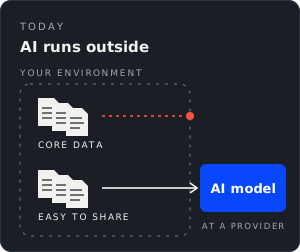
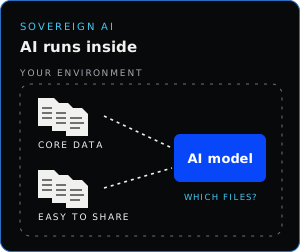
This has become practical. Capable open-weight models now run on your own GPUs. Infrastructure vendors now sell reference architectures for on-premises AI data centers, including air-gapped options built on open models (Constellation Research; SecurityBrief).
Moving the model inside your boundary answers where AI runs. It does not tell you which of the millions of files on your file servers a use case should read, or which files hold data that must be locked down even from internal AI. Point a private model at a file share without knowing that, and you get the same problems inside your own walls: weak answers, and sensitive data reaching people who should not see it.
Two Questions for Every File
Before core data is connected to AI, every file needs two answers. Is it relevant to this use case and the questions people will ask? And how must it be protected? Both come from reading the content. A file's name, path and permissions say where it sits and who can open it, not what it holds.
Most organizations cannot answer yet, according to BARC research co-sponsored by DataXray.
- 29%
- fully know where their AI-relevant data lives
- 36%
- know where their sensitive data lives
- 70%
- say less than half of their unstructured data is discoverable and usable for AI
- Relevance. Classification labels tell a use case which files it needs: the contracts with one counterparty, the engineering documents for one program, the claims files for one product line. An assistant that searches a labeled set is more likely to give a useful answer, and costs less to run, than one searching a whole file share.
- Protection. The same labels decide the controls: which users may see a file, which model may read it, and whether sensitive values are masked or the file is kept from AI altogether. Customer records might be cleared for a self-hosted model but never for an outside API. Export-controlled designs might be off limits to AI entirely.
- Clean-up. Classification also finds what should not be there: duplicates, stale copies and files past their retention period. Remove them and there is less to search and less to defend.
DataXray is built for this. It runs inside your environment, on-premises, in a private cloud or air-gapped, and reads each file where it sits, including scans, archives and email attachments. It classifies with pattern rules, machine learning and language models that run on your own infrastructure, so no file content leaves to be classified (DataXray platform). It holds an Authority to Operate on three networks in the U.S. Department of War.

With the AI Platform module, assistants and agents read only the files the AI-use policy allows, with each category set to allow, redact or block. Access can be limited to each user's own permissions in DataXray, policy can route runs to self-hosted models, and every decision is logged.
Where to Start
Start with one use case that needs core data and has a business result you can measure. Then classify the repositories it needs where they sit, set the policy, and run the AI inside your boundary. Each step gives you something to show the board.
- Pick a use case with a number attached. Tie it to revenue, cost or compliance: faster contract review, fewer outside counsel hours, quicker answers to regulators. If you cannot name the number, it is another generic assistant.
- Classify the data where it lives. Connect read-only to the file servers, NAS and private cloud stores the use case needs, and classify every file in place. DataXray has 55+ native connectors, plus a universal connector where no native one exists. It reads about 72,000 files an hour, around 1,200 a minute, at hundreds of thousands of words per second.
- Set the policy for each category. Decide which users, which models and which use cases may touch each category, and what gets masked or blocked.
- Run AI inside the boundary and measure the result. Use self-hosted models where the data requires it, check every request against the policy, log what was read, and report the business result rather than the number of prompts.
Questions to Answer Before You Connect Core Data to AI
If you cannot answer these for a use case, it is not ready for your core data. Each answer should come from evidence you can show, such as a classified inventory and a written policy, rather than from what people believe is in the files.
- Which use case will this AI serve, and what business number will it move?
- Which repositories hold the data it needs, and where are they?
- What share of those files has been read and classified, not just listed?
- Which categories must never leave your environment, and which must never reach AI at all?
- Will the AI see only what the person asking is allowed to see?
- Where do the model, the index and the logs run, and who can reach them?
- If your board or a regulator asked which files an answer came from, could you show them?
If some of these are still open, that is where to start. Book a demo to see DataXray read and classify files inside your own environment.
Frequently asked questions
What is sovereign AI for an enterprise?
Sovereign AI is AI that runs where your data lives and under your control: your models, compute, indexes and logs, inside your own data center, private cloud or air-gapped network. Your data and your users' questions do not go to an outside AI provider.
Do AI providers train on my company's data?
Under the major labs' enterprise terms, not by default. Consumer AI apps can train on chats unless the user opts out, and providers still see how their models are used, which is why many companies keep their core data away from outside AI services.
Why is classification the first step to sovereign AI?
Running a model inside your boundary decides where AI runs, but not what it reads. Classification tells you which files each use case needs and how each one must be protected, so a private model reads the right data and nothing it should not.
Can governance tooling run in my own environment or air-gapped?
Yes, if it was built for it. DataXray deploys on-premises, in a private cloud, hybrid or air-gapped, and runs its language models on your own infrastructure, so file content never leaves your environment to be classified.